Here is the mathematics I propose for calculating the acceleration of a satellite.
Use a radio technology to transmit and receive signals from the satellite. We will take the radio waves to be travelling at the speed of light 3 x 10⁸ m/s. At R1, R2 and R3 in the diagram below there are radio transmitters/receivers which will be communicating with the satellite. Program a loop to record the times when signals are received and transmitted from R1, R2 and R3. The distances, d1, d2 and d3 can be calculate from receivers R1, R2 and R3 respectively using the formula for speed. The success of calculating will depend on the processing speeds and precision of the timers and other sensors;
Distance (m)= Speed (m/s) x Time (s).
Where 2dn = Speed of Light x The difference between the transmitted and received times.
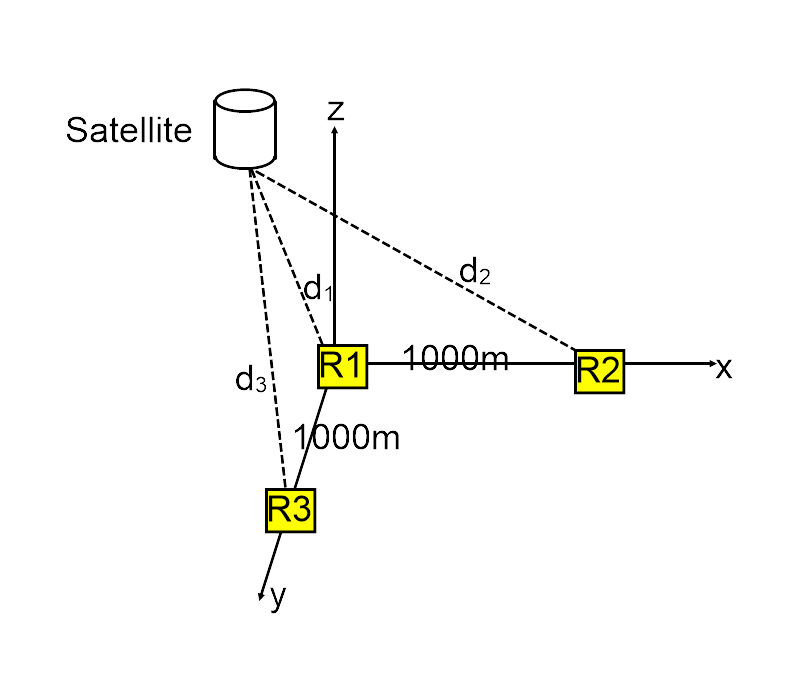
Once the data is recorded we will need to synchronize our d1, d2 and d3 values which were taken from the same position.
To find our displacement in cartesian coordinates at a given time.
The x, y and z distances can be found in the following way;
d1 2 = x2 + y2 + z2 (eqn1)
d2 2 = (x+ 1000)2 + y2 + z2
d2 2 = x2 +2000x + 1000000+ y2 + z2 (eqn2)
d3 2 = x2 + (y+ 1000)2 + z2
d3 2 = x2 + y2 + 2000y + 1000000+ z2 (eqn3)
d2 2 – d1 2 = 2000x + 1000000 (eqn2 – eqn1)
x = (d2 2 – d1 2 -10000000)÷2000
d3 2 – d1 2 = 2000y + 1000000 (eqn3 – eqn1)
y = (d2 2 – d1 2 -10000000)÷2000
z can be found by substituting x and y back into eqn1.

So our displacement r of our satellite is;
r = xi + yj + zk where i, j and k are unit vectors in the directions of the components x, y,and z respectively.
The velocity can be found by calculating the change in the displacement components over consecutive time intervals, data will need to be analysed to ensure the most suitable time interval is used;
v1 = (x1 -x0)/(t1 -t0)i + (y1 -y0)/(t1 -t0)j +(z1 -z0)/(t1 -t0)k,
v2 = (x2 -x1)/(t2-t1)i + (y2 -y1)/(t2-t1)j +(z2 -z1)/(t2-t1)k,
v3 = (x3 -x2)/(t3-t2)i + (y3 -y2)/(t3-t2)j +(z3 -z2)/(t3-t2)k,
…….
The acceleration can be found by calculating the change in the velocity components over consecutive time intervals, data will need to be analysed to ensure the most suitable time interval is used;
a2 = (vx2 -vx1)/(t2-t1) i + (vy2 -vy1)/(t2-t1)j +(vz2 -vz1)/(t2-t1)k,
a3 = (vx3 -vx2)/(t3-t2) i + (vy3 -vy2)/(t3-t2)j +(vz3 -vz2)/(t3-t2)k,
a4 = (vx4 -vx3)/(t4-t3) i + (vy4 -vy3)/(t4-t3)j +(vz4 -vz3)/(t4-t3)k,
…………..
 Pythonstem